Los Buches of Arrecife 2026: The Oldest Carnival Tradition in the Canary Islands
Los Buches of Arrecife represent the most authentic expression of traditional Carnival in the Canary Islands. Documented since 1711, this unique maritime tradition combines music, dance, and the characteristic gesture of playfully striking passersby with inflated fish bladders. Each February, the Parranda Marinera de Buches parades through the historic streets of Arrecife, keeping alive a custom that connects the city to its seafaring past and makes it guardian of the oldest urban Carnival in the archipelago.
What are Los Buches
The buche is the stomach of the Atlantic mako shark, which once inhabited waters near the Canary Islands. Arrecife’s fishermen would inflate these bladders after curing them in brine and drying them, creating a kind of sonorous balloon they used during Carnival to deliver harmless blows to anyone they encountered.
This striking tradition has roots that some historians trace to the Roman Lupercalia, where blows were believed to promote fertility. Similar customs survive in other Canarian carnival expressions like the Diabletes of Teguise or the Carneros of El Hierro, and in mainland Spanish traditions like the Pantallas de Xinzo. What makes Los Buches unique is their distinctly maritime and urban character, while other Canarian botargas have pastoral, rural origins.
History of Los Buches
The earliest documented references to Los Buches date to 1711, establishing Arrecife as home to the oldest urban Carnival in the Canary Islands. However, it was French anthropologist René Verneau who provided the first detailed description of the tradition during his visit to the island coinciding with the 1880 Carnival.
Verneau described men and women fishers disembarking with “strainers and ribbons on their faces, as well as peasant clothing.” Researcher Ricardo Reguera has documented how Lanzarote’s traditional dress from the 18th-19th centuries served as the basis for the buchero costume: buche in hand, mesh mask, shoulder shawl with flower at the chest, head scarf, ribbons on the cap, and white gloves.
Between 1922 and 1928, the Lanzarote Fishermen’s Guild formalized the Parranda Marinera de Buches, preserving the folk music and dance associated with the tradition. In 1924, photographer Aquiles Heitz captured images of Los Buches with musicians in suits and ties, and dancers dressed in colorful shawls and vests.
The Franco dictatorship banned Los Buches in 1936. It wasn’t until 1963 that a group of fishermen led by Wenceslao Noda Hernández decided to revive the tradition, founding the current Parranda Marinera de Buches. “Our founders were quite daring people — they decided in the middle of the dictatorship to form a maritime parranda association and go out into the streets dressed in metal masks during the harshest years of the dictatorship,” recalls Juan Antonio Machado, current president of the association.
The Parranda Marinera de Buches today
The Parranda Marinera de Buches currently has about 40 active members and a hundred collaborating associates. In 2023, marking its 60th anniversary, the group received the Gold Medal of the Canary Islands, the region’s highest cultural honor, with support from institutions including the César Manrique, José Saramago, Mararía, and Juan Brito foundations.
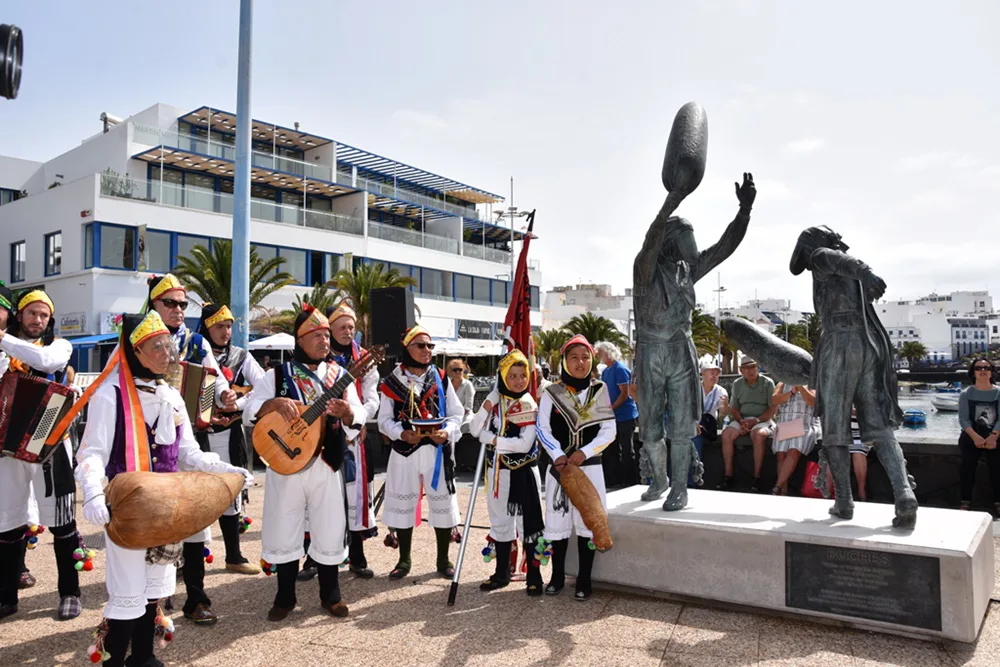
The city of Arrecife has honored the parranda with a bronze sculpture beside Charco de San Ginés and a street bearing its name. In the image accompanying this article, you can see parranda members next to this monument, which depicts two bucheros in traditional dance.
A pioneering conservation project
In July 2025, Lanzarote took a decisive step in protecting this intangible heritage. The situation was critical: restrictions on Atlantic mako sharks and natural wear had reduced the number of original usable buches to just twelve.
An international team from the Factum Foundation for Digital Technology in Conservation digitized the historic buches using high-precision photogrammetry and recorded their acoustic characteristics. The result: 35 synthetic replicas that respect the form, color, and sound of the originals. This project, unique in the archipelago, has the backing of CACT and SPEL-Tourism Lanzarote, and has received a formal invitation for presentation at Oulu 2026, European Capital of Culture.
Characters of the Traditional Carnival
Alongside the bucheros, the Traditional Carnival Parade of Arrecife includes other recovered figures:
Las Sábanas (The Sheets): Elegant 19th-century costumes that completely cover the body in white, evoking ghostly carnival figures from that era.
Las Mascaritas: Traditional characters like Don Pepe García, Charlot, or historical figures that add theatricality to the parade.
Los Gigantes (The Giants): Large-scale figures anticipating future heritage recoveries within the Parranda’s project.
Los Buches Parade 2026
On Saturday, February 22, 2026, at 10:30 am, Arrecife’s Muelle de la Pescadería hosts the traditional Los Buches Parade, the most important event in Lanzarote’s traditional Carnival.
Route: The parade departs from Muelle de la Pescadería, crosses Arrecife’s historic center through streets that were the scene of the ancient Entrudo, and ends at Plaza de Las Palmas. There, the Carnival Parranda leads a masked ball open to all attendees.
Carnival Torrijas: Attendees who come in costume receive traditional Carnival torrijas (fried pastries), courtesy of CACT. 200 portions will be distributed.
Banderas del tiempo: On Friday, February 13 (8:00pm), the Parranda Marinera de Buches presents a stage show at CIC El Almacén paying tribute to the Danza de Los Buches through music, dance, and theater. A celebration of Arrecife’s seafaring roots as part of the Traditional Entrudo.
Toward recognition as Intangible Heritage
The Parranda Marinera de Buches is currently working toward recognition of this tradition as an Intangible Cultural Asset of the Canary Islands. The long-term goal is to achieve recognition as Intangible Cultural Heritage of Humanity by UNESCO, following the path of other European carnival expressions.
The digital conservation project, the recovery of traditional figures like Las Sábanas and Los Gigantes, and the documentation work carried out by the association are part of a comprehensive effort to place Los Buches on the world heritage map.
Practical information
Los Buches Parade 2026
Date: Saturday, February 22, 10:30am
Starting point: Muelle de la Pescadería, Arrecife
Arrival: Plaza de Las Palmas
Entry: Free
Banderas del tiempo
Date: Friday, February 13, 8:00pm
Venue: CIC El Almacén, Arrecife
Tickets: culturalanzarote.sacatuentrada.es
How to participate: Attendees who come in costume — not necessarily as a buchero — receive free torrijas. The Parranda welcomes new members who play instruments or want to participate as dancers.
→ Complete guide: Lanzarote Carnival 2026
→ Lanzarote Cultural Agenda February 2026
Updated: February 4, 2026. Sources: Parranda Marinera de Buches, Cabildo de Lanzarote, Biosfera Digital, La Voz de Lanzarote.