Fiestas de San Ginés: Arrecife’s Patron and the Sangineles
The patron saint of Arrecife was born some 3,000 kilometers from the Atlantic, in central France. San Ginés de Clermont was the bishop of a city ringed by volcanoes in the Auvergne, died in the year 662, and can hardly have imagined that a fishing port in Lanzarote would carry his name thirteen centuries later. Local legend explains how he got here: a painting of him turned up floating in the seawater lagoon that now sits at the center of the city.
Who San Ginés de Clermont was
Ginés was the twenty-fifth bishop of Clermont, in the French region of Auvergne. After five years as bishop he wanted to withdraw into monastic life and set out for Rome dressed as a pilgrim, but ended up returning to his diocese. He founded the abbey of Manlieu and the church of Saint Symphorian in Clermont, where he was buried. The universal feast day is June 3.
Arrecife celebrates him on August 25 instead. It is a local date, entirely its own, that does not line up with the saint’s official feast — one of those quirks port traditions invent for themselves and nobody bothers to correct. There is a neat coincidence between the two cities: Clermont-Ferrand sits beneath the largest volcanic chain in Europe. A patron from volcano country, for an island of volcanoes.
The chapel of 1574 and the mother church
The cult began with a chapel built in 1574 in what was then the Puerto del Arrecife, a modest anchorage that was not yet the capital of anything. It held an image of Saint Peter and the painting of San Ginés that, according to oral tradition, appeared floating in the lagoon.
A flood badly damaged the building and it had to be rebuilt in 1665. In 1798 it became a parish church, and the late Baroque carvings of San Ginés and the Virgen del Rosario inside date from that same year: both arrived from Havana, on one of those Atlantic routes that explain half of Canarian history. The tower went up in 1842. In 1978 it was designated the mother parish, and in 1990 it was declared a site of cultural interest.
The building combines black volcanic stone with whitewashed walls. Inside are three naves divided by semicircular arches on Tuscan columns, under a dark timber ceiling with Mudéjar influence. Behind the baptismal font hangs a symbolist painting by Alberto Manrique representing the fountain of life. It is open to visit any day of the year, and it is worth the stop even when nothing is happening.
The Sangineles: how the fiesta works
Arrecife’s patron saint festivities are known locally as los Sangineles, and they have been designated a Festival of National Tourist Interest since 1965. This is not a single day: the program runs across roughly two weeks of August and builds toward the 25th, the día grande, when the saint is carried in procession through the streets.
What sets these apart from other patron saint fiestas on the island is how maritime and how urban they are. The program changes every year, but the skeleton repeats:
Vela latina. Traditional lateen-sail races are the sporting spine of the fiesta, held in the Charco de San Ginés itself and out in the bay. This is a Canarian sailing tradition with wildly oversized rigging and aggressive handling, and it looks like nothing else.
Jolateros. Children’s boats built from sheet metal — tin, literally — rowed in races inside the lagoon by kids from the neighborhood. It is the most photographed image of the Sangineles.
The open-water swim. A crossing of Arrecife bay with decades of history behind it.
Lucha canaria. Canarian wrestling tournaments on Reducto beach, the archipelago’s own combat sport.
Ventorrillos. The traditional food and drink stalls set up along the waterfront, where a good share of the fiesta actually takes place.
The offering to the patron saint, with folk groups performing, plus the concerts and open-air dances that fill the Charco, Parque Islas Canarias and Reducto beach after dark.
The Charco de San Ginés, the setting
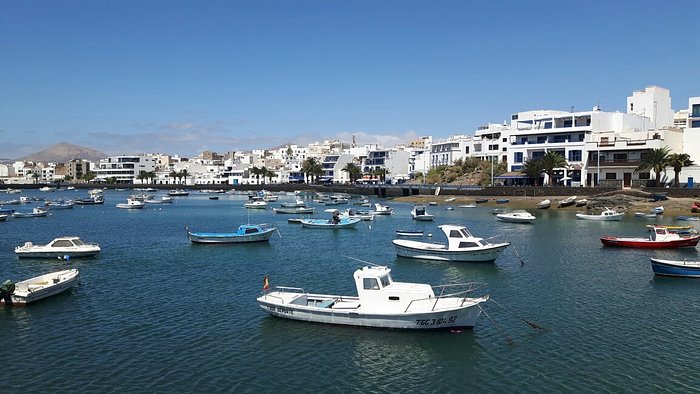
None of this makes sense without the Charco. It is a seawater lagoon set inside the city, joined to the ocean by a narrow channel, ringed by low whitewashed houses and moored boats. It began as a natural fishing anchorage: the lagoon sheltered boats coming and going, and in time it became the port that supplied the whole island.
Today it is the symbolic center of Arrecife and the place the city celebrates. Walking the perimeter takes twenty minutes and puts you past the patron’s church, the town hall, the Castillo de San Gabriel with its drawbridge, and within a few minutes of César Manrique’s El Almacén and Reducto beach.
How to experience the tradition
In August, during the fiestas. The two weeks leading up to the 25th hold the entire program. The Ayuntamiento de Arrecife usually publishes the poster and full schedule at a public presentation early in the month. If you are on the island in August, this is the best window to see the city operating as a city rather than a stopover.
Any day of the year. The mother church of San Ginés is open for worship and can be visited. The Charco never closes: it is the best urban walk in Arrecife first thing in the morning or at dusk, when the light comes in low across the water.
At carnival. If the maritime tradition of Arrecife interests you, its other great expression arrives in February. → Los Buches de Arrecife, the seafaring parranda documented since 1711, shares its origin with the Sangineles: this city’s relationship with the sea.
→ To get your bearings month by month, start with Lanzarote in August. And if you are planning a full trip, our guide to things to do in Lanzarote covers the essentials.
Published: August 1, 2026. Official sources: Ayuntamiento de Arrecife, Memoria de Lanzarote.